
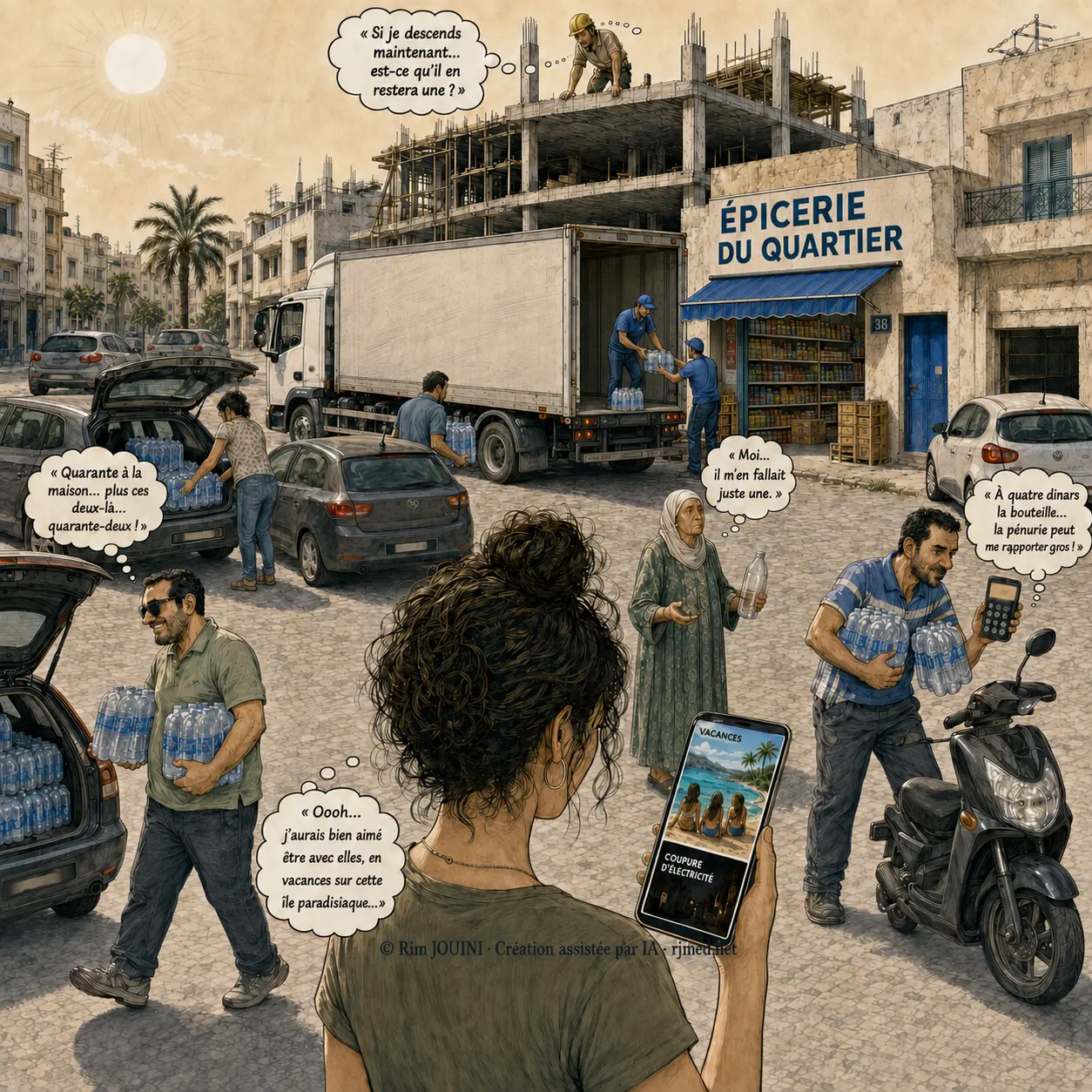
Mental overload is not always dramatic or visible. It can build in layers: anticipating another outage, searching for water, working through oppressive heat, following distressing news, then opening a phone to see other people’s seemingly perfect holidays. The body carries on while the mind remains engaged, with no genuine opportunity to recover.
What the caricature shows: several realities in one frame
Outside the neighbourhood shop, everyone is experiencing the same shortage differently. A construction worker wonders whether a bottle will remain when he can finally come down. An older woman asks for only one. The last packs in the lorry are already being taken. A reseller spots an opportunity. In the foreground, a young woman sees both a paradise island and news of a power cut on the same screen.
She makes no comment. She absorbs everything. Her silence carries the message: material constraints, uncertainty, idealised images and other people’s emotions can accumulate before we even understand what is exhausting us.
Is “mental load” a medical diagnosis?
In everyday language, mental load describes the invisible work of remembering, anticipating, monitoring, organising and planning. It can also describe the feeling of having too many unresolved concerns open at once. The term is descriptive; on its own, it is not a medical diagnosis.
Stress is a normal response to pressure or a perceived threat. It may be brief and can sometimes help us mobilise. When it persists, prevents recovery or interferes with daily life, however, it deserves attention. The World Health Organization notes that prolonged stress can affect sleep, concentration and appetite and may worsen existing health problems.
Why accumulation may weigh more heavily than one major event
Attention is finite. Every disruption calls for a decision: should I leave now, change my plans, verify this information, call someone or conserve a resource? Even when no immediate action is possible, the mind may continue rehearsing the problem.
Each concern may look “too small” to explain the fatigue, which can lead us to blame ourselves for not coping better. Yet exhaustion may result less from one dramatic event than from the absence of recovery between repeated demands.
Staying informed without remaining on alert all day
Useful information helps us organise. Continually refreshing the same feed, reading every comment and allowing alerts to interrupt every activity does not necessarily provide greater control. It can simply keep attention locked onto threat and uncertainty.
A more protective routine might involve checking the news at one or two chosen times, relying on a small number of identifiable sources, disabling non-essential alerts and stopping when no genuinely useful information is being added. Staying informed does not require continuous exposure.
Social comparison: seconds of footage, a complete story in our minds
On social media, we may compare our entire day — responsibilities, finances, health, fatigue and limitations — with a few selected seconds from someone else’s life. A holiday post may be genuine without showing what happened before or after the camera was switched on.
Enjoying a beautiful image is not the issue. Concern begins when content repeatedly leaves us feeling inadequate, unsuccessful or left behind. As our article “Why am I not losing weight despite my efforts?” explains, another person’s online routine is neither a medical prescription nor a measure of our worth.
Signs that genuine mental recovery may be needed
People respond to stress differently, but persistent changes may suggest that the mind is no longer recovering adequately:
- difficulty concentrating, making decisions or completing a simple task;
- feeling overwhelmed even when the list looks short;
- irritability, constant worry or difficulty releasing tension;
- disturbed sleep, waking tired or ruminating at bedtime;
- headaches, muscle tension, digestive problems or palpitations;
- withdrawing from others or increasingly relying on smoking, alcohol or other ways of numbing distress.
One temporary symptom does not establish a disorder. Duration, intensity, repetition and impact on daily functioning are what matter.
What does genuine mental recovery look like in practice?
It is more specific than simply “taking a break”. The aim is to interrupt whatever is maintaining the overload and give the mind a period with no new decision to make. Start with a defined interval — twenty or thirty minutes, for example — without news, notifications, shopping or social comparison. A walk at a cooler time, a shower, a conversation unrelated to current problems, slow breathing, prayer, music or a manual activity may help, provided the recovery period does not become another task to perform perfectly.
- Unload: write concerns down and separate what needs action today, what can wait and what is outside your control;
- Set boundaries: decide when news checking starts and stops, especially in the evening;
- Reduce interruptions: silence non-essential notifications and place the phone out of reach for the chosen period;
- Return to physical needs: hydrate, eat regularly, move within your ability and seek a cooler environment during extreme heat;
- Share the load: talk to someone you trust rather than carrying every possibility alone;
- Protect your mood: mute accounts that repeatedly trigger comparison, without guilt.
Putting things into perspective is not denial. It means returning each problem to its proper place, choosing the action that is possible now and no longer asking the brain to solve all day what remains beyond its control.
When should you seek professional help?
Consider speaking with a doctor, psychologist or psychiatrist when distress persists, these adjustments no longer bring relief, or stress disrupts sleep, work, studies, relationships or everyday self-care. Seeking help does not require the situation to be “severe”; early support can clarify what is happening and identify appropriate care.
Urgent help is needed if there are thoughts of suicide, a risk of harming yourself or someone else, severe disorganisation, an uncontrollable crisis or an inability to remain safe. Contact local emergency services or go to the nearest emergency department, accompanied if possible.
Frequently asked questions
Does limiting exposure mean ignoring real problems?
No. Deliberately suspending news and notifications for a defined period does not remove the difficulty. It prevents continuous exposure from draining the abilities needed to respond.
Why can positive posts make me feel worse?
A happy image can become a point of comparison during a difficult period. That response does not make you jealous or ungrateful; it may simply signal that some temporary distance would be protective.
Must I leave social media completely?
Not necessarily. Targeted boundaries around timing, notifications and followed accounts are often more realistic than a total ban. The aim is intentional rather than automatic use.
The RJMed perspective
Self-care is not limited to visible treatments, body shape or what we see in the mirror. It also means protecting the inner space through which we interpret the world. This caricature does not mock hardship; it shows what hardship can quietly leave in our minds.
We can remain informed, supportive and clear-eyed while stopping new demands for a defined period. That recovery time does not erase the world; it may help us return to it with greater calm and clarity.