
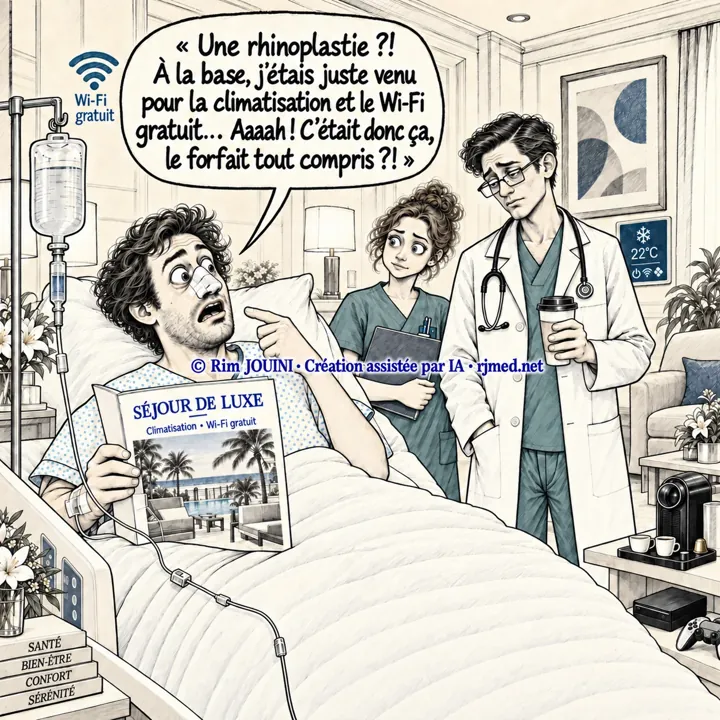
“I only came for the air conditioning and free Wi-Fi...” In the RJMed cartoon, the patient almost discovers afterwards that her package included rhinoplasty. Nobody truly books surgery for an Internet connection. The exaggeration makes another point: when medical travel uses the language and imagery of holidays, care can start to look like an extra added to a tourism product.
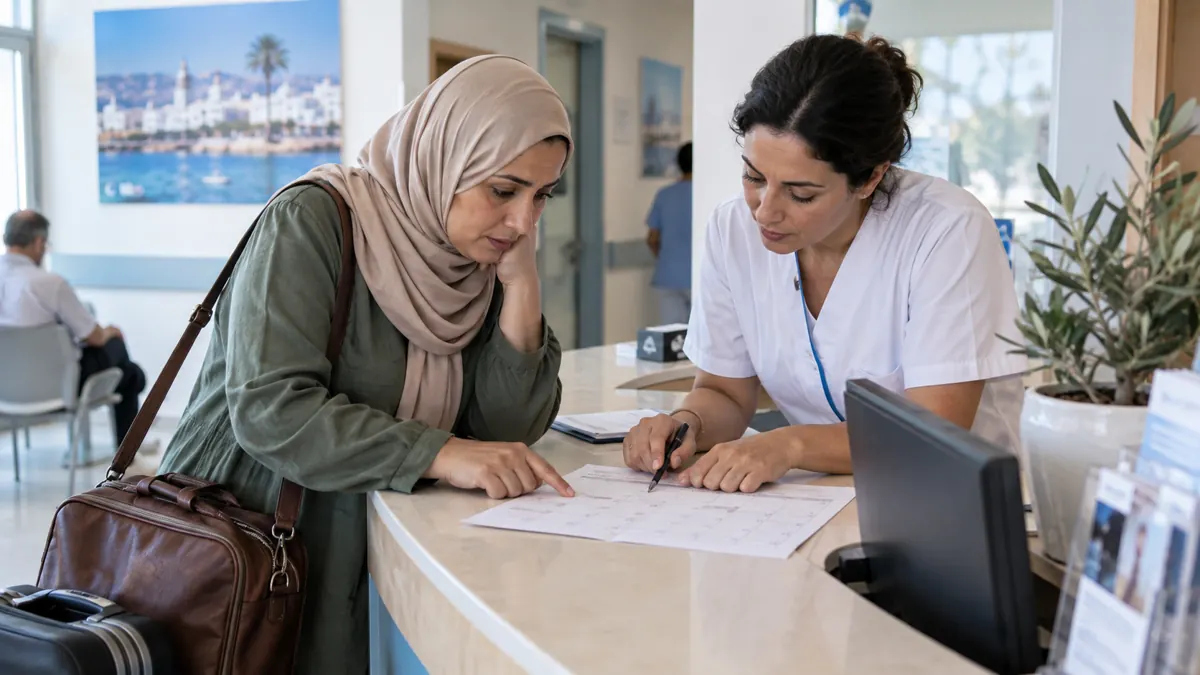
When words change the way we imagine the stay
“Package”, “all-inclusive”, “complimentary”: these familiar words suggest a clear price, fewer arrangements and peace of mind. In tourism, that is exactly their purpose. In cosmetic surgery, the same reassuring language gathers very different things under one label.
A hotel room is hospitality. A transfer is logistics. Surgery is an individual medical decision. All three may belong to one stay; placing them together does not make them equivalent.
Why Wi-Fi is easier to display than a sound indication
Comfort is easy to photograph, price and compare: a room, a car, a number of nights, free Internet. Essential clinical work is less spectacular. A reasonable indication, time spent reviewing a case, an adapted technique or a decision to postpone surgery rarely fits into an attractive tile.
Communication naturally highlights what can be seen. That says nothing by itself about the team's quality; it simply explains why readers sometimes need to look behind the image for what is not photogenic.
A traveller, a customer and a patient in the same person
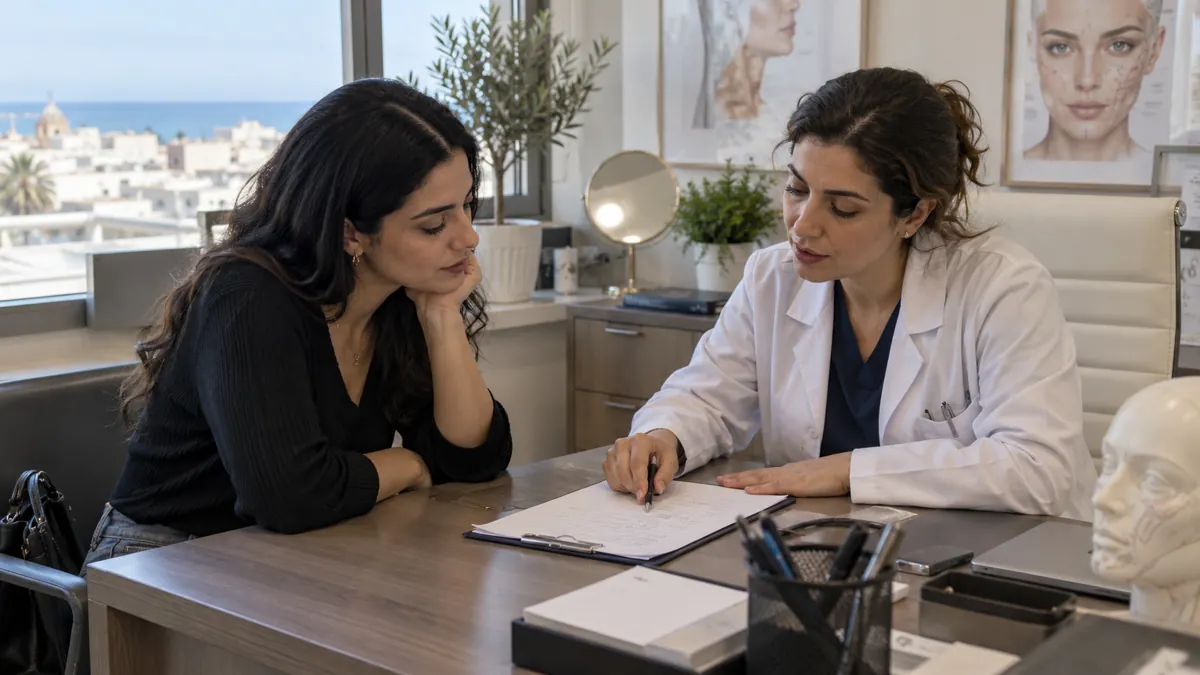
Someone coming to Tunisia for surgery is a traveller when booking a flight, a customer when choosing accommodation and a patient when entrusting health to a team. None of these roles cancels the others. Confusion arises only when the logic of one decides on behalf of another.
The hotel can be chosen as a hotel. Surgery is discussed with an identified cosmetic surgeon in a suitable clinical setting. An agency or coordinator connects the stages and makes the pathway smoother. Clear roles do not complicate the stay; they make it intelligible.
Tunisia is more than a price or a hotel room
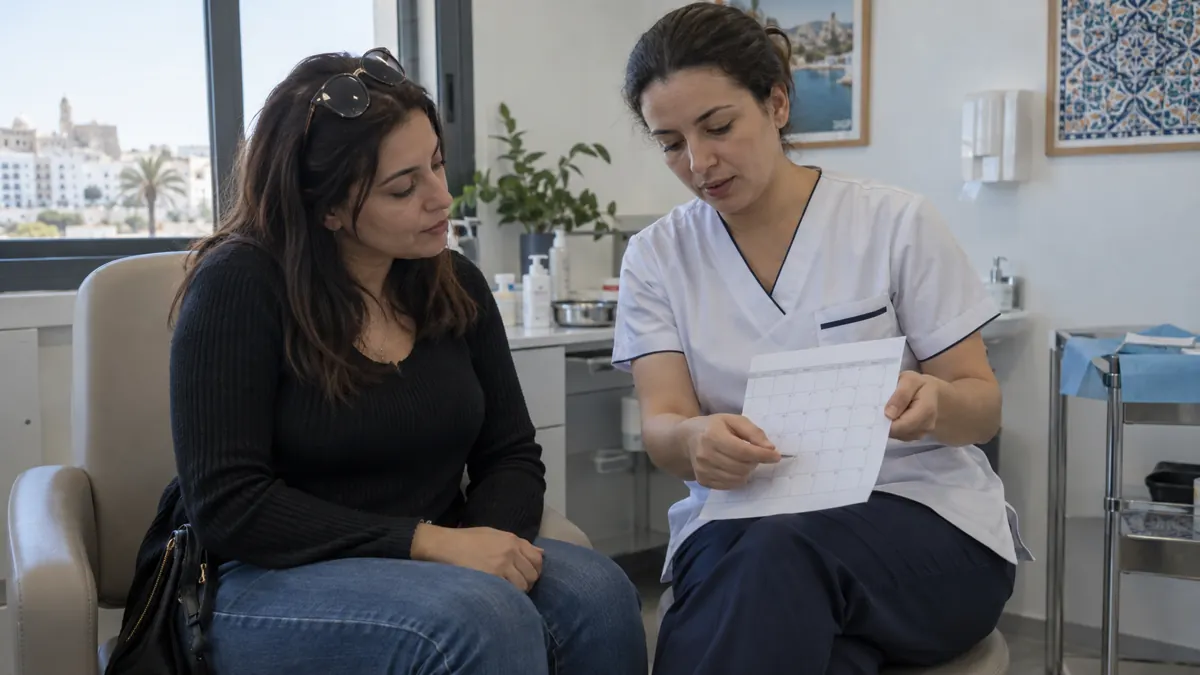
Tunisia's appeal comes from a richer combination: established cosmetic-surgery experience, trained professionals, medical infrastructure, proximity to Europe, a culture of hospitality and often more accessible prices. Reducing that proposition to “cheaper” removes precisely what can build confidence.
Price remains important and concrete. It deserves to be understood rather than turned into a slogan. RJMed's guide to cosmetic surgery prices in Tunisia explains quotations and exclusions without repeating them here.
Rhinoplasty is not a souvenir from the trip
The bandaged nose gives the cartoon its force. A rhinoplasty in Tunisia affects facial balance and may involve breathing. Its plan grows from an examination, discussed expectations and anatomical limits. The stay is then organised around that decision, not the other way round.
This also separates surgery from a tourist activity: it continues after discharge. Swelling, tiredness, reviews and timing the journey home belong to the real experience, even if they seldom appear on a brochure cover.
Three promises, three ways to read them
- The medical promise: what the team proposes for this person, with benefits, limits and follow-up.
- The coordination promise: how appointments, travel and communication are organised.
- The hospitality promise: the accommodation, welcome and services that make the stay gentler.
A good package can unite all three. Distinguishing them is not about sacrificing one, but knowing who undertakes what. See the RJMed guides to the medical stay and the composition of an all-inclusive package for practical detail.
What if true premium care is what cannot fit in the photograph?
Luxury in a medical stay may be more than a large room or premium car. It can mean time to reflect, a contact who genuinely knows the case, a precise answer when plans change, a clinic suited to the procedure and continuity once the patient returns home.
These qualities are harder to stage than a welcome tray. They are also what patients remember when the stay does not follow the script exactly.
“All-inclusive” is not the problem
When well designed, it simplifies a complex organisation. Patients can appreciate a coherent price, comfortable room, punctual transfers and attentive coordination. The RJMed nuance lies elsewhere: the setting should extend care, not tell the whole story in its place.
The cartoon deliberately reverses priorities to make them visible. Someone may come to Tunisia for the quality of a medical plan and fully enjoy the comfort around it. That is where the package finds its best meaning: not surgery slipped into a holiday, but a thoughtfully planned medical stay, pleasantly organised.