
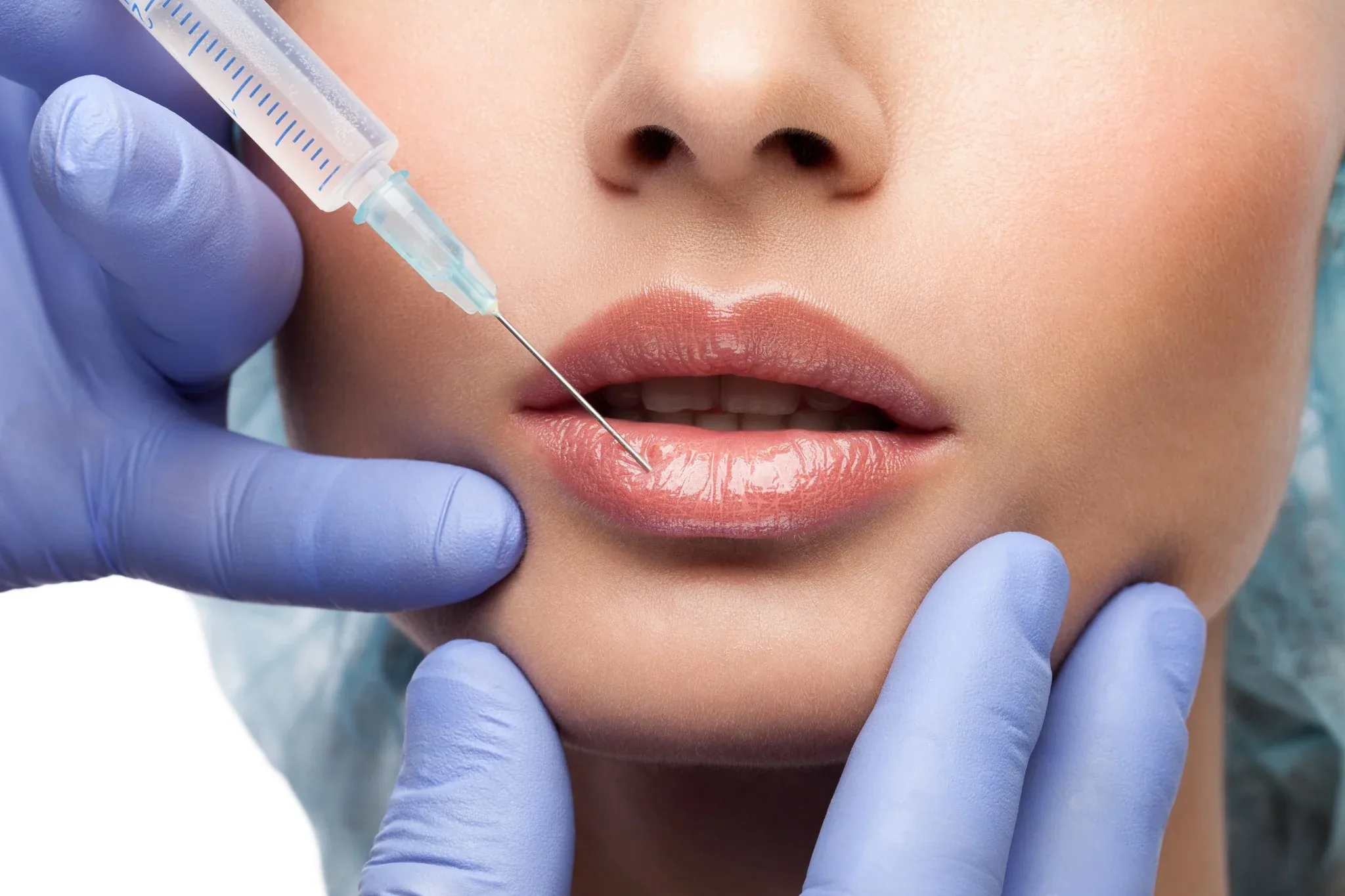
With aesthetic injections, restraint, medical assessment and the choice of a qualified specialist matter more than trends. This is not a contest between a “natural” face and an injected one. A well-indicated treatment may soften a wrinkle, restore volume or balance a feature while preserving expression. The problem begins when correction becomes accumulation—or when a real face is asked to resemble an image designed for a screen.
The photographer asks for a smile, but the face no longer shows it
In our cartoon, the old photographer and camera recall portraiture that tried to capture a person: a gaze, an expression, even an asymmetry. They do not glorify a past without aesthetic treatment; they remind us that a portrait is more than perfected contours.
The woman genuinely feels that she is smiling, yet the drawing’s deliberate exaggeration makes that expression difficult to read. Her cat does not condemn her; he humorously adapts to kisses now delivered in “suction-cup mode”. The joke targets excess, never the person seeking an aesthetic improvement.

Wanting to soften a wrinkle is not unreasonable
RJMed will not pretend that even an expensive cream can do everything. Cosmetics may hydrate, protect and improve texture or radiance. They do not mechanically fill a deep wrinkle or restore lost volume as a properly indicated medical procedure can.
For someone genuinely bothered by a wrinkle or volume loss, a measured injection may therefore make more sense than repeatedly buying luxury products with unrealistic promises. The treatment must still match the indication: hyaluronic acid can fill or restore selected volumes, while botulinum toxin reduces the activity of muscles responsible for certain expression lines. They are not interchangeable.
Young people too: when the request is no longer about ageing
Young adults may seek projected lips, a sharper jawline, a stronger chin, higher cheekbones or the profile of someone they follow online. Their face is not old; it is being judged against a current “Instagram-ready” standard.
Filters, retouching, frontal lighting, selected angles and algorithms repeatedly display the same codes. Observational studies report associations between social-media use, appearance concerns and more favourable attitudes towards aesthetic procedures. Association does not prove that social media alone causes an individual request, but it gives the consultation good reason to explore where the request came from and how stable it is.
After seeing the same archetype often enough, an ordinary human face can appear incomplete when it is simply real. Repeated use of a filter may also make the unfiltered reflection feel less familiar.
A reference photograph is not a spare-parts catalogue
A photograph can communicate a preference; it cannot order one person’s lips, another’s chin and a third person’s jawline. Bone structure, skin, soft tissues, profile, movement and proportions differ. A feature that flatters one face may unbalance another.
The relevant question is not only “can it be done?” but “what happens to the balance of this face if it is done?”
How excess develops without one dramatic decision
- a first correction is satisfying, then the eye adapts to it;
- familiar volume seems less visible although it remains present;
- a new trend redirects attention to another area;
- filtered photographs become the benchmark for judging reality;
- lips, cheeks, chin and jaw are treated separately without reassessing the whole face.
There is no universal quantity that defines “too much”. Product, area, anatomy, previous treatments and time all matter. Warning signs may include reduced expressiveness, increasingly standardised proportions, dissatisfaction that continually moves to a new area, or the belief that a visible result has disappeared.
What a proper consultation should evaluate
The doctor should examine the face at rest and in movement, review previous procedures and discuss realistic outcomes. Useful questions include: Did this concern exist before the filter or trend? Has it remained stable? Is the aim a focused improvement or a general transformation? What is expected in real life beyond photographs? Did earlier procedures produce lasting satisfaction?
If appearance concerns become consuming, lead to constant checking, social avoidance or repeated procedures that never satisfy, an immediate injection is not the automatic answer. A suitable assessment may be more protective.
A good doctor also knows when not to inject
Technical skill is essential but insufficient. A serious specialist can recommend less, space appointments, reassess after swelling resolves, explain when a goal conflicts with anatomy, or refuse a disproportionate procedure.
For checks concerning medical qualification, product traceability, setting and follow-up, read our guide to safe aesthetic injections in Tunisia.
Enhance without standardising: RJMed’s position
RJMed supports competent, measured and honest aesthetic medicine. A wrinkle may legitimately be softened; an appropriately selected dermal filler may restore volume or balance a feature. But a face is not a blank page for every trend.
For an older person, the risk may be trying to erase every trace of time. For a younger one, it may be replacing their own features with those rewarded by this season’s front-facing camera.
Frequently asked questions
Can injections look natural?
Yes, when a suitable indication, conservative amounts, sound technique and respect for proportions preserve movement and identity. “Natural” does not mean risk-free or guaranteed.
At what age can aesthetic injections begin?
There is no universal adult age. The indication depends on the request, anatomy, product, medical history and maturity of expectations. Youth makes a procedure neither automatically necessary nor automatically unjustified.
Can an influencer’s photograph be used as a model?
It may illustrate an intention but cannot guarantee a copy. The image may be filtered and the anatomy differs. The doctor must translate the preference into a realistic goal for the face being examined.
How do I know whether I am asking for too much?
Increasingly frequent touch-ups, dissatisfaction that moves from one feature to another, difficulty seeing an existing result, or a need to match an image exactly are good reasons to pause and reassess.