
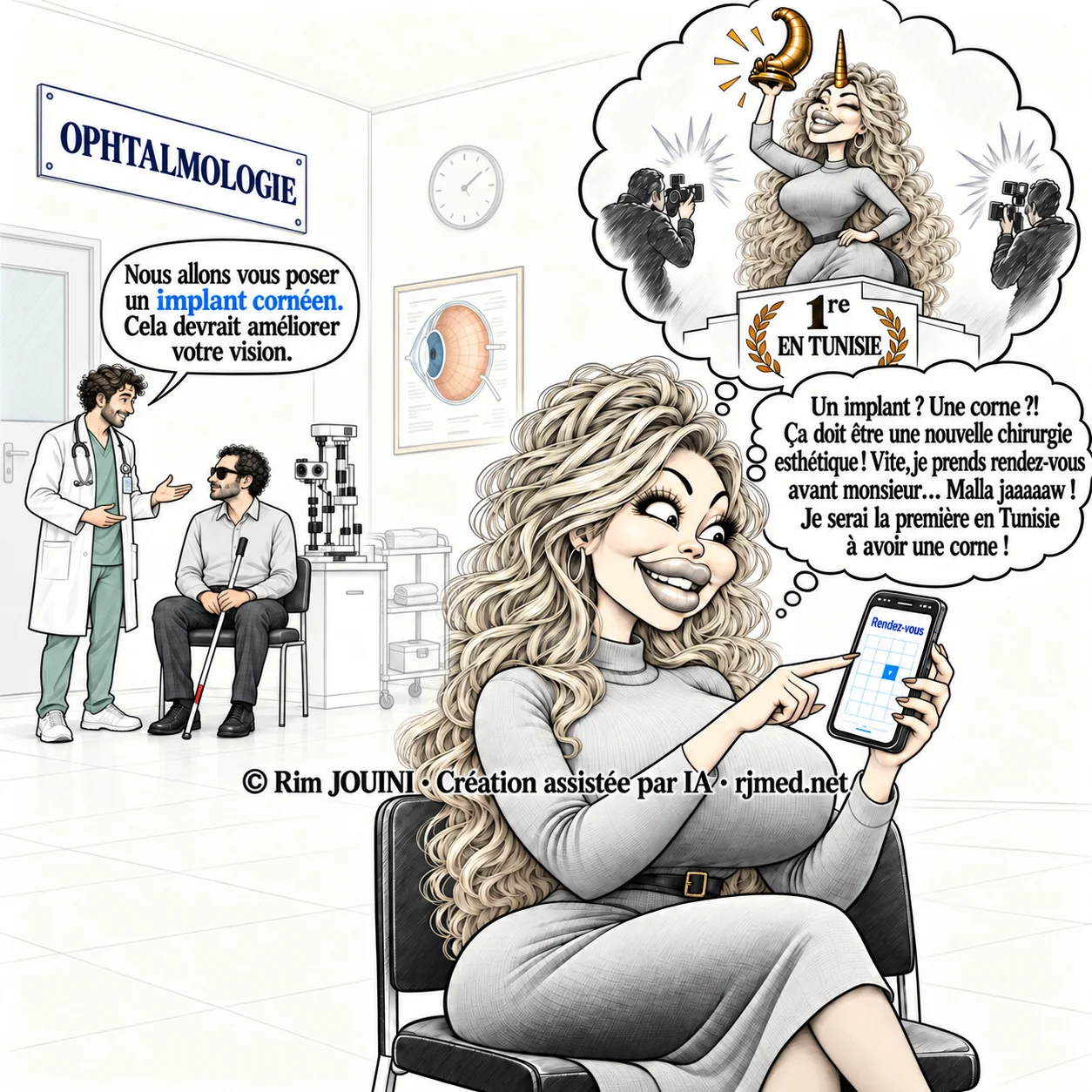
A doctor is discussing a corneal implant with a visually impaired patient. In the waiting room, a woman catches only two words: “implant” and “corneal”. The first instantly sends her mind towards cosmetic surgery; the second turns into a “horn”. Seconds later, she is booking an appointment and picturing herself on a podium, photographed as the first woman in Tunisia to display this new transformation.
Two words overheard, a procedure already invented
The misunderstanding is not simply “corneal” becoming “horn”. The word implant matters just as much. In the character’s imagination, it automatically belongs to cosmetic surgery. Combined with “corneal”, it produces an absurd but irresistible invention: a horn-shaped implant.
The medical scene behind her says something entirely different. The patient is attending ophthalmology because of his vision, and the doctor is discussing a treatment for a specific indication. The cartoon offers no advice about corneal implants; it uses the contrast between real healthcare and the spectacular interpretation created from fragments.
She had never heard of it — and already wants it
The character arrived with neither a defined concern nor a long-standing wish. Desire appears at the exact moment she thinks she has discovered something new. She does not ask what the procedure treats, who it is for, what its limits are, or even whether it exists. Her first move is to seek an appointment.
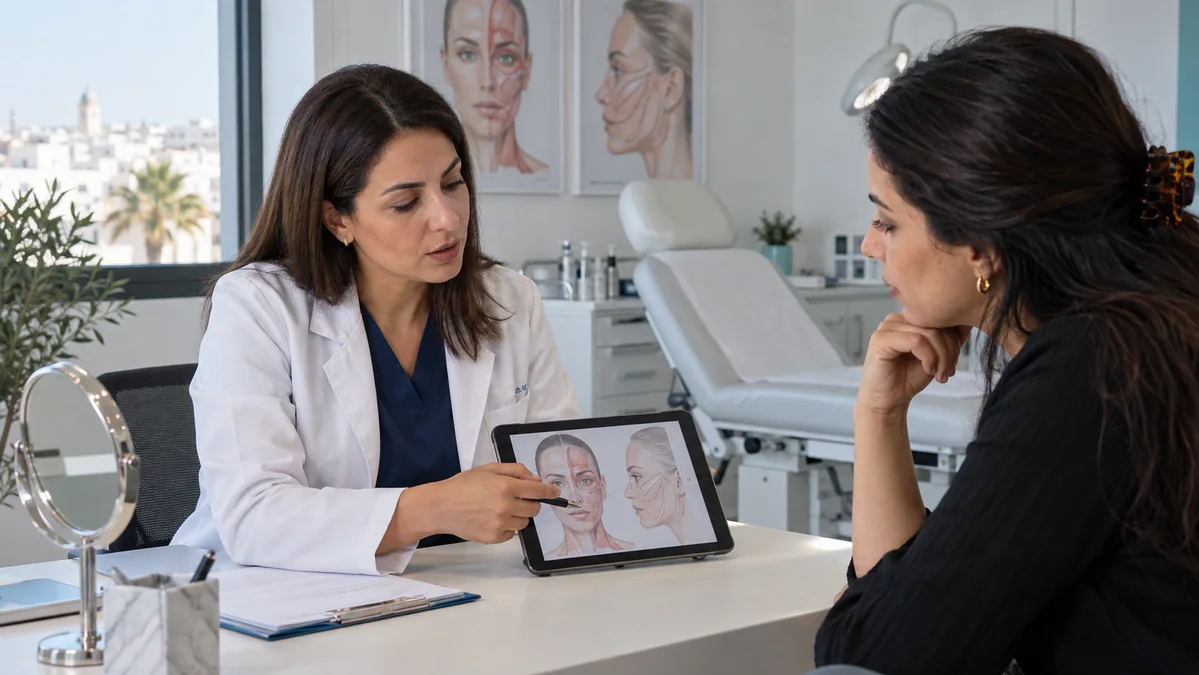
This shortcut drives the scene: desire arrives before understanding. A cosmetic surgery request is more usefully built from a personal question — what someone wishes to change and why — before it meets the name of a technique. RJMed’s guide to cosmetic surgery in Tunisia therefore presents procedures through their aims, recovery and limits, rather than novelty alone.
Her appearance already tells a story of accumulation
The XXL lips and cheeks, pronounced body volumes and deliberately unrealistic waist are not accidental details. They belong to the language of caricature. They suggest someone who has already pursued highly visible transformations and for whom the surprise produced in others may have become important.
This is not a judgement on a body, nor a claim about which procedures the woman has had. Exaggeration describes a dynamic: the “horn” would not be her first transformation, but the next distinctive piece. When yesterday’s spectacle becomes familiar, something rarer may seem necessary to recover the same attention.
This connects with, without repeating, our article about “Instagrammable” features and excessive injections. Here, the subject is not quantity but the role social distinction can play in a decision.
Before imagining the result, she imagines the photographers
Inside the thought bubble, there is no consultation, operating theatre or recovery. She sees herself triumphant, horn in hand, surrounded by flashes and crowned “first in Tunisia”. The first benefit she imagines is not anatomical; it is narrative.
Being first supplies a story. It can mean surprising friends, attracting attention, appearing more daring or possessing something others do not yet have. Surgery then becomes less a response to a bodily concern than a way of creating an event around oneself.
A competition whose finish line keeps moving
First place has one weakness: it is temporary. Once a technique spreads, others adopt it or a new trend appears, exclusivity loses its force. If satisfaction depends mainly on getting there before everyone else, it needs constant renewal.
The competition shifts from appearance to timing: who did it first, who will take the next step, and who will display the most spectacular result? Reflection can then feel like a risk of losing one’s place, even though time is exactly what protects freedom of choice.
Other people’s gaze can influence even a seemingly precise request. Our article on blepharoplasty and fox eyes explores how an eye shape popularised through images may be confused with a medical indication.
Medical innovation is not a novelty to collect
Surgery advances through new techniques, devices and knowledge. Being recent does not make a method suspect; nor does novelty automatically make it suitable for everyone. Its value depends on the problem it addresses, the evidence around it, its limits and the competence required to offer it.
Medical innovation is designed to answer an indication more effectively, not to award first place. Even when a technique is available in Tunisia for the first time, that fact alone says nothing about its relevance to a particular person or the result they might obtain.
Choosing a cosmetic surgeon is therefore not about finding whoever offers the newest technique. It also means meeting a plastic surgeon able to explain why it does — or does not — fit this particular request.
The consultation begins where the competition ends
An unusual request deserves neither automatic mockery nor immediate acceptance. It deserves a conversation. The clinician explores what the person wants to change, how long the wish has existed, what they expect to feel afterwards and how much other people’s reactions matter.
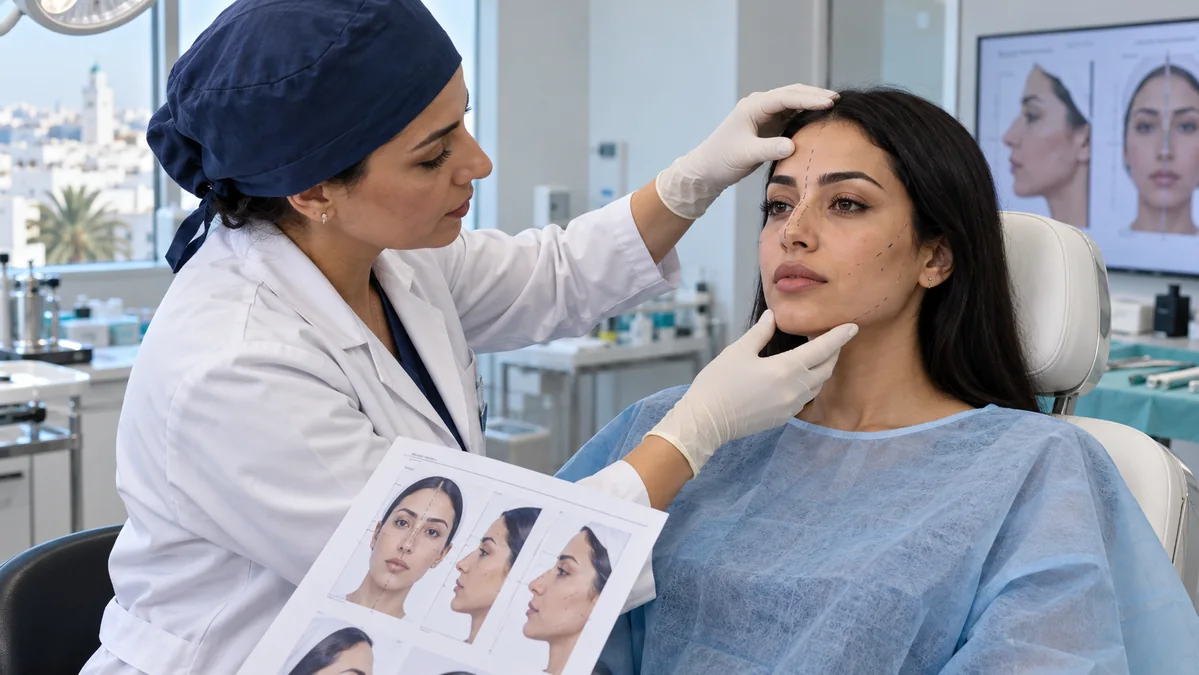
Professional guidance emphasises exploring motivations, expectations and psychological needs, while giving patients enough information and time to decide. Speaking directly with the plastic surgeon who will perform the procedure also brings the imagined image into contact with real possibilities and limits.
The setting matters too. A suitable cosmetic surgery clinic in Tunisia and a qualified team support a safe pathway, but they cannot turn a competitive impulse into a personalised indication. That coherence is built through medical assessment.
If nobody could know, would she still want it?
This does not mean surgery should be secret, nor that socially influenced desires are automatically false. Few choices are formed outside the gaze of others. The question simply creates space to sort different motivations.
If the podium disappeared, if nobody could like, comment or ask where it was done, would the change retain the same value? Could the person describe the desired outcome without the words “new”, “rare” or “first”? Would the wish remain after the technique became commonplace?
There is no podium in a medical decision
Cosmetic surgery can be recent, unusual and fully considered. It may provide genuine physical or psychosocial benefit when the wish is personal, expectations are realistic and the indication is coherent. RJMed argues neither for immobility nor fear of innovation.
The cartoon targets a different shift: wanting to win first place before knowing which procedure one is seeking. In that situation, waiting, exploring or deciding against surgery does not show a lack of courage. It may simply place the person’s own project ahead of the spectacle promised to others.
In cosmetic surgery, being first is not an outcome. Recognising yourself in the decision matters far more than your place on an imaginary podium.
Professional sources
This discussion draws on the General Medical Council guidance on motivations, expectations and consent and the Royal College of Surgeons professional standards.