
A woman may be frightened before she even knows what she should be frightened of. This paradox describes the days that may separate finding a change from having it assessed. Imagination moves faster than appointments, gathers memories and turns a possibility into a complete story. Acknowledging this does not dramatise the situation or imply that fear is “all in the mind”. Fear is real even when the story it constructs has not yet become true.
Fear of knowing: while I do not seek care, nothing is confirmed
Delaying an appointment may look irrational from the outside, yet it is not always indifference. Some women fear that consultation will move a vague concern into reality. Not knowing becomes fragile protection: the word has not been spoken, the calendar has not changed and life still resembles yesterday.
Uncertainty does not stay empty. It fills with scenarios, repeated checking, sleepless nights and promises to book “tomorrow”. RJMed’s first carousel tells precisely this lived interval. The monster under the bed is not a decorative fiction; it expresses fear growing in darkness before an examination brings facts.
Fear of the word “cancer”: every story we have heard returns
The word “cancer” rarely arrives alone. It brings back a neighbour, an aunt, an acquaintance or a colleague’s wife. We heard she was ill, learned that she had surgery, noticed her short hair or sent a message of support. At that point, we were looking from the outside, with compassion.
Then a change concerns us personally. Fragments of other people’s stories suddenly gather: “she lost her hair”, “her treatment was difficult”, “nobody expected it”. Yesterday’s compassion becomes projection onto oneself. Illness stops being someone else’s story and becomes an intimate possibility.
Those memories predict neither another woman’s diagnosis nor her treatment or future. Two women can hear the same word without living the same disease or pathway. Memory assembles stories; medicine still has to establish facts.
Fear of the examination
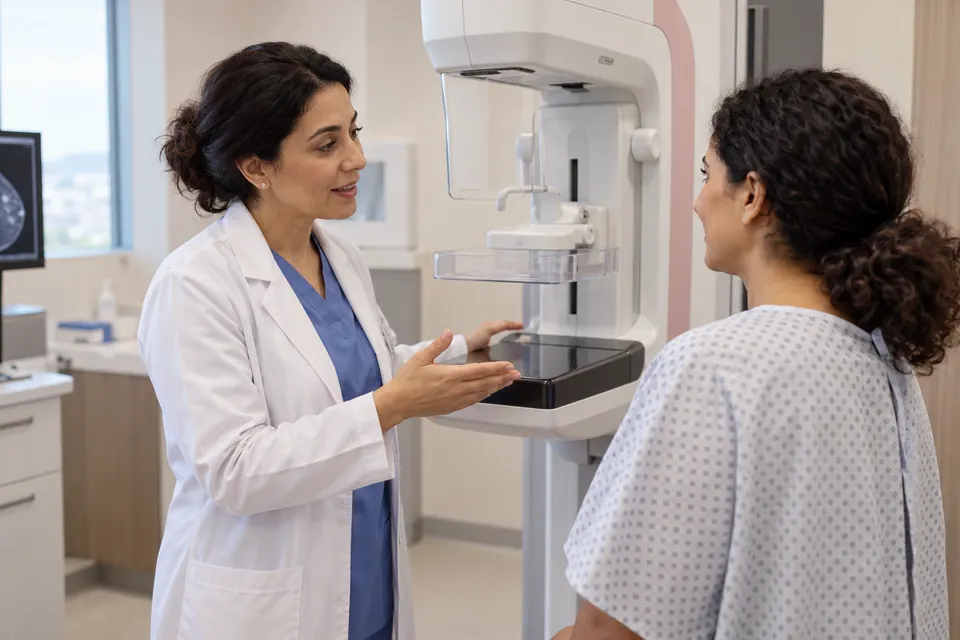
Mammography may be feared because of compression, possible discomfort, undressing, the equipment, waiting or the possibility that one test may lead to another. Saying “it is nothing” or “it never hurts” dismisses differences in sensitivity.
A concrete explanation restores some control: what will happen, how long each stage lasts, whom to tell if it hurts and when results are expected. Information may not remove all apprehension, but it reduces the power of the unknown.
Fear of diagnosis: the moment life might change direction
The frightening part is not only a result. It is everything it might move: work, children, partnership, plans, money, responsibilities and one’s sense of being healthy. Some women think first of themselves; others immediately think of everyone who depends on them.
Returning to the present step — the next appointment, question or result — does not deny the future. It avoids having to live every possible version of it at once.
Fear of surgery and losing a breast
A breast is not merely anatomy. It may be connected to femininity, motherhood, sexuality, intimacy or the familiar image of one’s body. Fear of surgery, particularly mastectomy, may therefore appear before any diagnosis or treatment plan exists.
Not every situation leads to the same operation. Surgery depends on the disease, its extent, breast characteristics, other treatments and decisions discussed with the medical team. Reconstruction may be immediate, delayed or not wanted. Before describing techniques, the fear deserves recognition: waking in a body one already imagines as different.
Fear of treatment, hair loss and no longer recognising oneself
Hair loss has become one of cancer’s most visible images. It can concentrate fears about treatment, public attention and lost privacy. Stories about fatigue, nausea and bodily change may join it, often without the medical context that shaped someone else’s experience.
Women do not all receive the same treatment, and treatments do not all have the same effects. This matters medically, but it should not be used to dismiss emotion. A person can fear a transformation before knowing whether it will occur.
Fear of a partner’s gaze and other people’s eyes
“Will my partner still look at me in the same way?” The question holds desire, intimacy and the fear of becoming someone to protect rather than a woman to love. Family concern can also feel heavy when every look contains only worry.
Then come awkward silences, glances towards the chest or hair, and “poor thing” offered with good intentions. A woman may need support without wanting to become her disease. Look at her, not only at what she is going through.
Fear of never being “the same as before”
This may concern the body, energy, confidence, sexuality, work and a sense of safety. Yet “the same as before” means something different to each person. Some want familiar landmarks back; others know that an important experience will leave a trace.
No woman should be forced into the story of the permanently strong fighter or a perfect return to normal. She may be recovering and still afraid, resume life without erasing what happened, laugh while remaining tired, and love her body while needing time to recognise it.
When all the fears speak at once
Separating them can be a first step. Is the fear about the test, its result, pain, telling children or a partner’s gaze? A named fear becomes a question that can be taken to the right person.
- Separate facts from projections: what was observed, what was explained and what imagination added;
- write questions down and ask for answers in understandable language;
- choose support from someone able to listen without imposing their own scenario;
- limit accumulated stories: personal accounts may accompany but cannot predict an individual pathway;
- seek psychological help if anxiety prevents sleep, eating, work or attendance at examinations.
Switching on the light does not promise that there is nothing under the bed. It means no longer allowing imagination to tell the story alone.
RJMed’s position
Fear is neither a lack of courage nor poor patient behaviour. It deserves to be heard, but it is not a medical result. Your fear exists. You can look at it without entrusting it with the whole story.